
USFans Tracking: Follow the Parcel That Contains Your Items
Your saved product reference, purchase order and international parcel describe different things. Before interpreting a USFans tracking update, identify which parcel contains the items you expect. A change to the parcel plan can leave an earlier reference attached to only part of the purchase.
USFans' tracking instructions checked on 30 September 2026 direct you to “Tracking Details” for the selected parcel. Start there after matching the contents; use the purchase guide if your items have not yet reached the parcel stage.
Start with the parcel contents
Open the parcel record through your established account access and compare its contents with your plan. If some items were left in the warehouse, they should not inherit the dispatched parcel's status. Use the warehouse guide to separate those received items from the selected shipment.
Imagine a hypothetical basket with a crewneck and a backpack. You send the crewneck first and leave the bag for later. A movement event for the first parcel tells you nothing about the bag's international journey. Keep both decisions distinct even though the products were originally saved together.
If a parcel has been replaced or split, establish which reference applies to each resulting shipment. Do not assume the newest number describes every earlier item.
Copy the identifier from the matching record
Use the tracking reference associated with that parcel, including any carrier context shown. An order identifier is not automatically a carrier tracking number. Avoid reconstructing a number from an incomplete screenshot or copying a nearby record by mistake.
If another local reference appears later, keep its connection to the original parcel rather than treating it as an unrelated purchase. Where that connection is unclear, ask support which reference corresponds to the delivery stage. A number that returns an event still needs to belong to the parcel you intended to inspect.
Keep full identifying references private when sharing an example publicly. A status question can often be explained with the event wording and dates without exposing the whole shipment record.
Read the event, not just the most reassuring word
Carrier terms have their own definitions. For example, UPS explains that a label-created status means shipment details have been received electronically, while possession of the parcel is a separate event. Its Access Point delivery description concerns arrival at a collection location, not necessarily receipt at the buyer's home.
Those are UPS-specific examples, not a claim that UPS handles your USFans parcel. Read the actual carrier's definition for the event in front of you. Do not automatically translate every “arrived” message into final delivery.
| What to keep | Why it matters |
|---|---|
| Parcel and reference | Connects the event to the intended contents |
| Carrier or service context | Identifies whose status wording you are interpreting |
| Event text | Shows what was actually reported |
| Event date and time | Places the reported movement in sequence |
| Time zone, if shown | Helps compare records without false ordering |
| Time you checked | Distinguishes the observation from the event itself |
Keep observation time separate from movement time
An account page checked this morning can display an event from yesterday. The time you opened the page is not the movement time. Likewise, two systems can present updates with different time-zone information or different last-refresh times.
Retain the displayed dates and labels. If the time zone is unknown, say so in your private notes rather than assigning one. Do not conclude that a parcel moved backwards solely because two unaligned timestamps look out of order.
When records appear to conflict, compare the parcel identity and exact wording before deciding that either is wrong. Preserve both observations for a focused support question.
Compare two screens without inventing a missing event
Suppose, hypothetically, your account displays an earlier event while the identified carrier's record displays a later one for the same parcel. Save each event's own timestamp and the time you checked each screen. Report the difference as a difference between the records; do not assign a movement time from whichever page you refreshed last.
If the references differ, first ask whether they describe separate parcels or linked stages of one delivery. Do not merge the two histories merely because both contain a familiar city name. A local delivery reference needs a confirmed connection to the international parcel before its updates can complete that timeline.
A useful private question is: “This parcel record shows this event at this time; the associated carrier record shows a different event at this time. Do both references concern the same shipment, and which stage does each describe?” Include the relevant identifiers through the proper private channel, not in a public post. This is a suggested question, not a message sent or a discrepancy observed in a real USFans account.
A quiet tracking record is a question, not a diagnosis
A period without a visible update does not by itself establish loss, a customs problem or a particular next event. Check the last reported stage, the applicable service information and any current notice through the established account or carrier route.
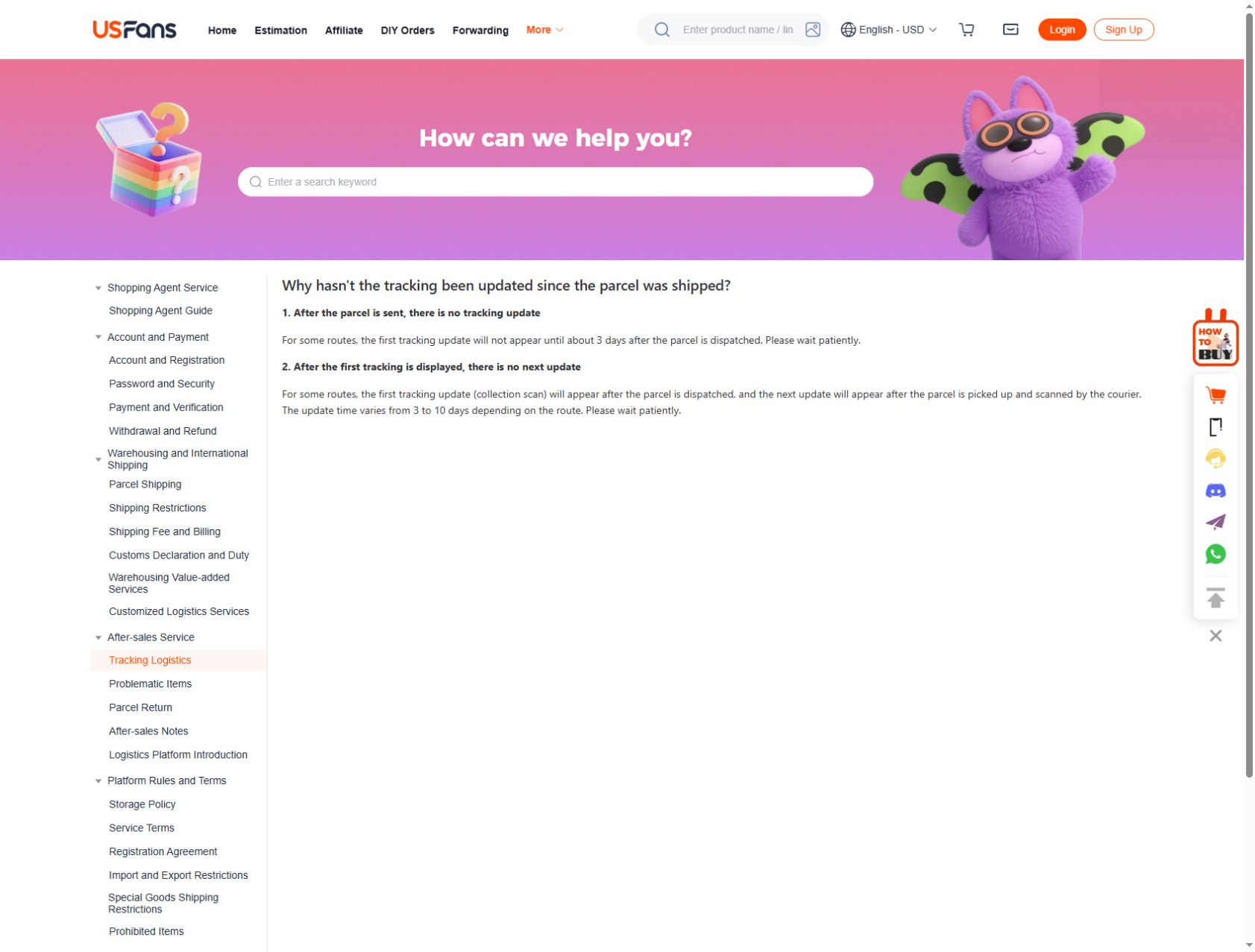
In the help page checked on 30 September 2026, USFans distinguishes two gaps on some routes: the first update may appear about three days after dispatch, while the interval before a subsequent courier update can vary from three to ten days by route. These figures describe possible tracking-update intervals, not delivery deadlines, and do not diagnose a particular parcel. Match the guidance to the stage and service shown in your own record.
Avoid inventing a universal number of days after which every parcel is lost. Timing depends on the service and circumstances, and the available record may not answer the cause. The delivery-time guide separates planning estimates from observed events.
Ask about a specific gap: which parcel, which last event, when it was shown and what has changed since. Include the parcel reference and the event you need clarified. A precise question is more useful than attaching another buyer's unrelated timeline.
If the record says delivered but you have not received it
Read the destination or collection context and any delivery information actually provided. Do not assume that a collection-point event means a handover to you. Equally, do not decide that the record is false without examining what it says.
Use the appropriate private support or carrier channel to clarify the reported event. Keep the parcel reference and relevant observation together. If you are seeking a remedy, distinguish the request from its eventual result; the returns guide does not make every delivery issue an automatic refund.
Keep browsing separate from the parcel investigation
If you are choosing a bag for a later purchase, inspect this backpack on USFans and save its selected option in that new shortlist. Keep the existing shipment's tracking record separate so a new product reference does not replace the parcel you are investigating.
If you want to understand the proposal made before dispatch, use the shipping guide. If you are evaluating somebody else's reported journey, use the review guide. Neither replaces the events associated with your own parcel.
Separate the question into the right stage
| Question | Record to examine | What a different record cannot prove |
|---|---|---|
| Was money recorded? | Relevant payment and transaction context | A product page does not show payment outcome |
| Which option was requested? | Purchase request and confirmed changes | The first saved image may show an earlier choice |
| Has the item arrived? | Matching received-item or warehouse record | Another item arriving does not complete this one |
| Was a correction accepted? | Request, reply and confirmed result | An acknowledgement alone is not completion |
| Has the parcel moved? | Parcel reference and event history | Item selection alone is not carrier movement |
If your uncertainty concerns money, use the payments guide. If it concerns a received unit, use the warehouse guide. For a dispatched parcel, move to tracking.
A basket can contain several unfinished paths
One product may be received while another is still being clarified. A third may have a remedy request attached to it. Do not compress those records into “everything is delayed” or “everything is ready.”
Decide what question belongs to each item. If you later split the shipment, associate each parcel with its actual contents. The shipping guide helps evaluate a changed parcel plan, while the delivery-time guide separates the waiting intervals.
Frequently asked questions
Does having a tracking number mean the carrier has the parcel?
Not necessarily. Read the applicable event and carrier definition; an identifier or electronic label is not the same observation as physical acceptance.
Can one number represent my entire shopping history?
Do not assume that. Match it to the parcel contents, especially after splitting shipments or leaving items in the warehouse.
Does this page provide a USFans package tracker?
No. It is a reading guide, not a live tracking service or a private account lookup.
Can another buyer's delivery time predict mine?
It can suggest questions, but it does not establish your next event or arrival date. Compare the actual service, destination and stage.