
USFans QC Photos: Match the Image to the Choice You Actually Made
A useful QC check begins before zooming into a seam. Establish whether the photographs concern the received item and the option you actually agreed to purchase. If you changed a size or colour, an old saved row can be the wrong comparison even when it shows the product that first attracted you.
Use the purchase guide to keep the requested option and confirmed changes together. Then compare that record with the corresponding USFans QC photos, asking for the specific view needed to settle your next decision.
A size sticker needs its item context
The public USFans Product QC close-up below shows a round S sticker on a pale paper hangtag, resting over black fabric and part of a white print. The letter is readable. The full garment and its sewn label are not shown in this frame, so the useful observation is “the paper tag is marked S,” rather than “the received garment has the agreed dimensions.”
For the changed-size question, pair a detail like this with an overview and the accepted option in the same private item record. If you requested a different size, compare against the confirmed change, not the first saved row. If the question concerns body length, request a measurement with both endpoints; another enlarged picture of this sticker would still answer only the marking question.
Start with the matching item record
Compare the received-item record with the selected product, option and quantity. Keep any agreed correction beside it. One image set from a basket does not describe all its items, and a repeated photograph is not another independent inspection.
If a picture was found publicly, establish its context before using it. It may show a seller's sample, another buyer's item or a different version. A useful public image can suggest a question, but it cannot prove the state of your unit.
The spreadsheet links guide addresses candidate identity. The warehouse guide concerns the received-item stage. Those are related checks, not interchangeable records.
Decide which image can answer the question
| Your question | Useful view | Limit to keep in mind |
|---|---|---|
| Is the requested size label present? | Legible label connected to this item | A label is not a garment measurement |
| Is a visible mark on the surface? | Clear detail plus a wider view locating it | Lighting and folds can change appearance |
| Does the garment have the needed length? | Measurement with endpoints and units visible | An undefined method prevents a fair comparison |
| Is a component included? | Relevant contents shown together | A sealed package can leave contents unobserved |
| Does it work or last well? | Information beyond a still appearance image | A photograph alone cannot establish performance |
Ask for the missing observation, not simply “better QC.” If you need to see the end of a zip, name that area. If you need a measurement, specify the endpoints so the response can answer your actual question.
Understand the inspection scope
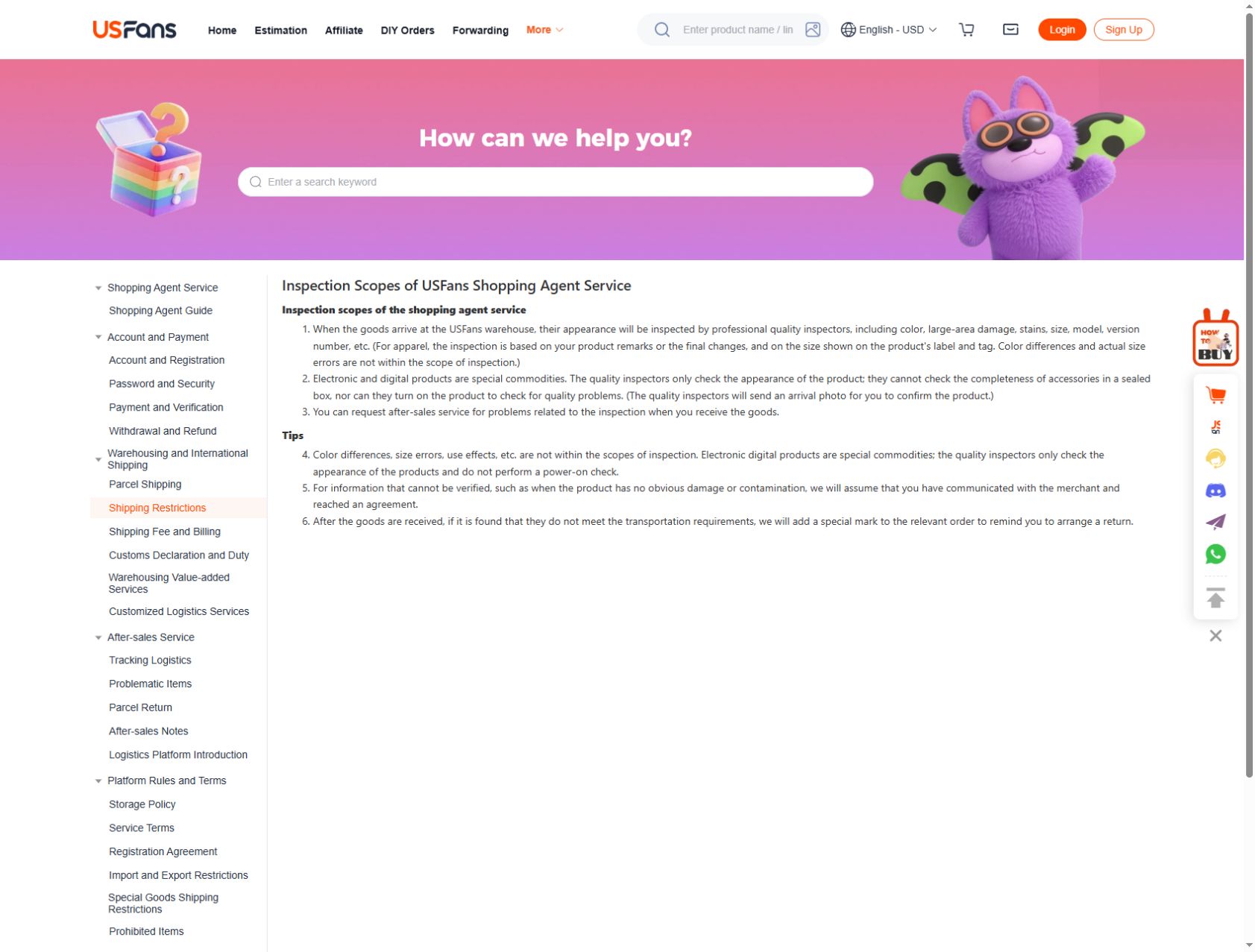
USFans' inspection guidance checked on 30 September 2026 describes appearance and garment-label checks, while excluding actual sizing errors, colour differences and use effects from its stated scope. For electronics, it describes exterior inspection without powering on the device or checking accessories inside a sealed box. A matching label can therefore settle the selected size code without answering whether the garment has your required measurements.
If that unanswered detail affects whether you keep the item, ask which additional view or measurement can be supplied and what it costs. Confirm the request conditions before relying on a free allowance or a particular turnaround.
Work through a changed-size example
Imagine a hypothetical crewneck originally saved in one size, then changed before purchase. The received label shows the later size. Comparing that label with the first spreadsheet row could make an intentional change look like a mistake.
First confirm what was agreed. Then consider fit separately: does a comparable garment measurement support the use you intend? The label can answer an option question while leaving a fit question open.
Inspect a hoodie candidate on USFans if a hooded layer fits your plan. Compare the selected design with images of your own received item, including the hood where relevant. The hypothetical crewneck example explains how to interpret a changed size; it does not supply this hoodie's QC images or measurements.
Use the size guide to define the comparison. Do not assign a measurement from a similar garment to this one because the relevant photograph is missing.
Ask for one view that changes the decision
If the issue is a mark near a cuff, a full front view might establish where it sits but not what it is. A close-up can show the area more clearly, yet lose its position on the garment. Together, appropriate views can support a more precise question without proving hidden composition or cause.
Do not turn a lighting difference into a definite material or colour conclusion. Describe what is visible and ask for clarification when it affects your choice. Similarly, an image of a closure at rest does not show repeated-use durability.
If a measurement is required, compare like with like. Record whether the garment is laid flat and where the ruler begins and ends. A number without the method may not resolve the original uncertainty.
Choose the next action from the result
You may have enough information for the visible question, need a specific further check, or decide to ask about a correction or return. Keep those outcomes separate. Accepting an appearance observation is not a declaration that every hidden property has been tested.
For a mismatch, retain the relevant selected option and received detail privately. Ask about the action available at the present stage with platform support. Use the returns guide before assuming that a particular remedy is available or that another buyer's conditions apply.
Resolve the item decision before including it in a parcel. The shipping guide addresses the later contents and packaging comparison, not the inspection of an unresolved unit.
Share pictures without exposing the order
Remove recipient details, account identifiers, identifying barcodes and unrelated messages before sharing an image publicly. Keep the part that answers the product question, and obtain permission before republishing another person's picture. Availability in a public group does not establish permission to reuse it elsewhere.
Do not count the same picture reposted on several sites as several purchases. The review guide helps distinguish an observation from the broader recommendation attached to it.
Frequently asked questions
Does this page provide a USFans QC finder?
No. It explains how to assess images and their connection to an item. It does not search private warehouse records or retrieve a matching image set automatically.
Can a seller photo replace received-item QC?
It can describe the advertised appearance, but it is not an observation of your received unit. Keep its role clear.
Do several photographs prove authenticity?
Photographs alone do not establish every property or origin claim. Limit the conclusion to the detail that can actually be observed.
Should I always request more images?
Request a particular view when it can answer a decision-relevant question, after checking availability and conditions. More images of the same unhelpful angle may not resolve anything.