
USFans Spreadsheet Links: Recover the Item, Then Recheck the Option
A saved USFans spreadsheet link is useful when it returns you to the candidate you meant to compare. Opening a page is only the first part of that job. You still need to establish which item is shown, whether your intended option is available and whether the next action is browsing or placing a request.
Keep the public product address and selected option together, then compare both after reopening the link. For a starting collection, return to the USFans spreadsheet home page; use the steps below when a saved row opens something unexpected.
Preserve the reference before trying a replacement
Keep the original public product address with the row's description and intended option. Avoid repeatedly overwriting it with whatever opens next. If you later find a replacement, you will need the original to understand whether you recovered the same candidate or changed your choice.
Keep private account and checkout links out of shared lists. If an address contains account or session information, do not publish it simply because it opened a product in your own browser. A reusable public reference and a private transaction page serve different purposes.
Identify what the destination actually provides
| What opens | What you have established | What remains to check |
|---|---|---|
| A specific product card | A candidate can be inspected | Item identity, seller where shown and intended option |
| A category or shop | A place to browse | Which exact product the row meant |
| Search results | Possible candidates | Whether any result matches the reference |
| A manual request form | A place to enter information | Whether the intended item and request can be accepted |
| An account page | A sign-in or private workflow | Whether this was the action you intended |
A search result is not proof that a conversion preserved the original item. A manual form is not confirmation that a purchase has been made. Use the destination according to what it does, rather than according to the label on the button that opened it.
Inspect a product reference without assuming an order
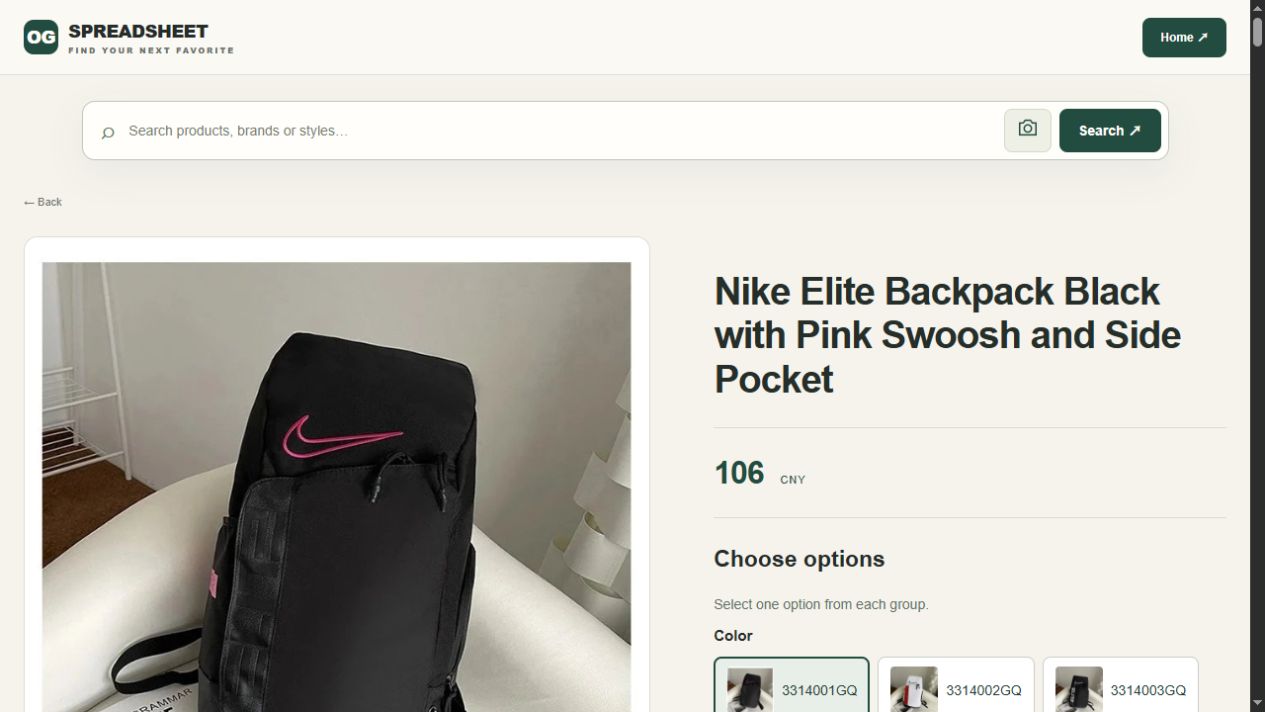
Open the backpack reference on USFans to compare the visible model, compartments and selectable version. It is a fixed candidate: keep your own saved reference alongside it if you are trying to recover a different bag.
After opening any candidate, compare the description and selectable options with the reference you saved. If your requirement concerns a compartment or dimension, establish that detail for the actual version. The photo of a similar bag cannot supply it.
The best spreadsheet guide helps judge whether a collection makes this comparison practical. A list can contain working destinations and still provide too little information to reconstruct the intended choice.
A correct item can still have the wrong option
Imagine a hypothetical saved row for a black bag. Its address opens a product family with several colours, and the page initially displays a different one. You may have recovered the product family, but you have not yet restored the selected option.
Check the colour, version, quantity and any included pieces before continuing. If the intended option is no longer selectable, mark it as a changed choice. Do not assume that the first visible option is equivalent or that the row's old amount applies to it.
For garments, this also means comparing the selected size and measurement definition. The size guide addresses that task. A link that opens successfully does not make an old size observation current.
When the link fails, keep the possible causes separate
An inaccessible reference can reflect a loading problem, a changed destination or an item that can no longer be identified from that address. One failed attempt does not distinguish those possibilities.
Check whether the address was copied completely and whether you were opening a public product or a private page. For a display issue, check the address and reload the page before changing your saved product reference. Do not make an account change or repeat a payment merely to test a product reference.
If the destination no longer identifies the item, use the saved description and images as leads. A visually similar result is an alternative until you have enough information to establish a match. Keep the alternative's own details separate; never attach the old item's inspection photograph to it as though they were the same unit.
The archive guide explains how an older row can remain useful as context even when it is no longer a usable purchase destination.
Checking one USFans link versus a list of USFans links
For a single reference, keep the original address and your intended option together. Follow one action at a time, then compare the final destination before trying another route. Otherwise, a later successful search can be mistaken for a successful conversion of the address that failed first.
For a list, inspect each row independently. A working shoe reference tells you nothing about the next jacket reference. Group rows by their actual outcome rather than marking the entire collection as working after opening its home page. If the same destination appears twice, compare the intended options before deciding whether you have duplicate rows or two genuinely different choices.
For example, imagine three saved bag rows. Two open the same product family, but one calls for black and the other for blue. The third opens a category. The first two still need separate option checks; the third has not recovered a product at all. This hypothetical example explains the checking method, not the current behaviour of three tested USFans links.
Keep changes reversible: save a replacement beside the original rather than silently editing the old row. If you already submitted a purchase request, changing your personal list does not change that request. Check the order itself before assuming that your new choice has carried over.
Keep a useful outcome note
Use a short outcome that distinguishes what happened: “same item, option checked,” “same family, intended option not found,” “alternative candidate,” or “reference unresolved.” These are suggested notes, not platform status codes.
If two saved rows reach the same item and option, they may be duplicate references rather than independent choices. Compare their actual destination before counting them separately. Conversely, similar photographs do not prove that two different destinations are interchangeable.
Preserve the date of your observation. It tells you when the check was made, not how long the result will remain true.
Move from reference to purchase deliberately
Once the candidate is clear, review the option in the actual purchasing workflow. Keep the product reference separate from the resulting order or parcel record. The purchase guide follows those transitions, while the QC guide explains why received-item images must match the relevant order.
If a destination unexpectedly asks for credentials or a code, assess it through the safety guide before entering information. A familiar product picture does not authenticate an account request.
Compare each field without rewriting its history
| Field | Preserve from the saved record | Establish in the new check |
|---|---|---|
| Reference | Address or identifier originally retained | Destination reached now |
| Item | Description available at the time | Identity supported by the current page |
| Option | Saved colour, size or version | Selectable option now |
| Amount | Earlier currency, quantity and observation | Current amount for the actual selected unit |
| Image | What the saved picture represented | Whether a new image concerns the same candidate |
| Date | Meaning of the recorded date | Date of your new observation |
The links guide explains how to interpret a changed destination. A working page and a recovered option are different results.
Keep three outcomes distinct
Recovered candidate: enough identifying information connects the reference to the item now visible. Still check its current option and conditions before relying on it.
Deliberate alternative: another candidate may meet the same need, but its details and history are separate. Explain the reason for replacing it in your private shortlist.
Unresolved reference: the surviving information is insufficient. Retain it as context if useful without presenting it as ready to order.
Two different saved labels may also lead to the same current destination. Check this before counting the results as separate options. Repetition can preserve history without increasing the number of candidates.
Frequently asked questions
Does this page convert links automatically?
No. It explains how to assess references and destinations. Its OG buttons open the specific browsing pages stated by their labels.
Can I remove everything after a question mark in an address?
Do not assume every parameter is irrelevant. Preserve the original privately while checking a public reference; avoid sharing any address that exposes private session or account information.
Is a similar image enough to call a result the same product?
No. Establish the item and option with the available identifying details. Otherwise, treat it as an alternative and compare it on its own merits.
What if a positive review says that every link works?
That statement needs a scope and date. Use the review guide to separate another person's browsing observation from the specific item and option you need now.